Blog #4 – Advertising Across Medias

Written on 11.8.21
Mountaineer Podcasting, Television Advertising, and Problem Solving
During the first week of November, my advertising management class was welcomed by three different presenters. The first group of presenters was Mountaineer Media, the second was Gray Television, and the third was the Problem Solver Consultants. These three presenters delved into the world of their online mediums and how marketing works within their fields.
Mountaineer Media is a local podcasting group from Charleston, WV, presented by Cooper Shimmerman and CJ Harvey. The company centers around a podcast done every week, where they’ll bring on guests who are well-known or are reputable residents of the West Virginia area. An example would include the President of WVU or the Current Police Chief in Office in West Virginia. The podcast’s goal is to highlight their guests to showcase how their guests make a difference for the state of West Virginia. Much about how these guys could start this podcast as a small group that has become a more prominent brand bringing on more guests. The most interesting discussion that I took from this panel was how Cooper and CJ defined their audiences. Granted, it’s a West Virginia podcast about West Virginians, so you can say the audience is WV residents. The most important takeaway from that conversation was using social media and navigating across the mediums in promoting their material. These guys were very informative to mention how they had to start sponsoring brands to earn more revenue. This intention helped the amount of money received when creating these programs while also supporting local businesses sponsored through their show.
Gray Television is an ever-growing media company that is currently expanding across the country with 100+ TV stations. Guest speakers Pat Shaffer and Tim came in to talk about their news station WDTV, where they have Gray Television licensed to advertise their TV station. They explained how impactful Gray Television has been growing across the country, even creating ads for people using streaming services and regulating local business advertising. It’s even good to see that Gray’s goal for their advertising is to be non-discriminatory towards any race or gender to reach a broad target audience. I have to admit that I was very enthralled with how the guest speakers orchestrated how the timing of ads worked when premiered on various media platforms such as TV and even streaming services. Learning how much ad time is regulated and scheduled during programs that premiered on television was cool because I always wanted to know the frequency of commercials.
The Problem Solver Consultants is a local agency from Buckhannon, WV, specializing in creating a marketing campaign for acquired clients. They help clients by making a marketing plan dedicated to spreading across social media and more for assigned services. Guest Speaker Mike Ruffing, the president and CEO of the company, pinned a conversation regarding the example of advertising from a Google Ad. His presentation centered around the longevity and effectiveness of a Google advertisement. Mike delved into how A.I. interacts with the human behavior that is concentrated using social media and various platforms that engage advertisements. It struck me how vibrant the constant fluctuation that a marketing campaign can be present for customers. Adding onto that idea, Mike insisted on the importance of finding a customer persona, which helps define what audience companies should intend on reaching and attracting. It’s a hard job in considering what the most effective way to intrigue an audience is, but marketers need always to be aware of almost every form of getting customers.
Improving YAA
If considering creating an IMC Campaign for each media, I’d contend they all have much of their corners covered. I mean that they have their corners covered by utilizing their advertising plans accordingly by knowing their audience, message, and product. Dissecting each of these different media for the sole purpose of creating my own advertisement campaign demonstrates a mass amount of help for contributing to my final project in the class. The final project instructs students to develop a new marketing campaign for our chosen non-profit organization. I decided to choose Young Artists of America, a non-profit organization that resides in the New England Region. It is a performance arts organization that teaches and educates up-and-coming students in middle and high school. The goal for what I’m trying to achieve for YAA is to expand its marketing, in the efforts to expand itself across the country.

Mountaineer Media gave great insight for creating a greater reputation by becoming a component to sponsor local businesses within the West Virginia area. Even with their podcast centering around notable West Virginian residents, they’ve designed their guest spots to be curated for the demographic type that would intend to listen to the podcast. I think what I could take away from Mountaineer Media is their advice on how to expand themselves on multiple platforms through Twitter, Facebook, TikTok, and much more. I think Young Artists should definitely look into making a consistent and present reputation being on social media so they can increase their awareness for artistic students in grade school and parents of students who are participating in arts programs in school. Even being an organization that is very communal within the New England area, the organization has expanded its participation capabilities for more ages and non-enrolled students. Growing and creating a stronger force of communication on social media platforms would only make the company much more stronger and successful. Generating revenue while promoting advertising for the product is also very essential to make the best efforts in sustaining as a company, where YAA should be competent in gravitating towards companies that can encourage its manifest to reach their destined audience.
Gray Television suggests what and how YAA could benefit from premiering ads on local or regional television. Even Gray’s intention to advertise products without any discrimination would advocate greatly for the efforts of YAA to encourage more diversity among race, gender, age, sex, and more. Utilizing a force of advertising as such would increase the variety of demographics of people who can participate in the programs. Using an element of what Gray uses to make ads for people, it can be directed to people who don’t watch cable tv, but who are using streaming services and searching the web. The Problem Solvers encaptured what it means to find the kind of audience a company should designate their attention towards and how conducting advertising research should be made in multiple places for the best outcome in reaching their target audience.
What does YAA Need to do?
In conclusion, I think my IMC Campaign should gravitate in using elements from the following presenters; Mountaineer Media taught me to be consistent on social media promotion and find adequate sponsors that can generate revenue to grow the company. Gray Television’s capabilities of having advertising without any discrimination should help grow the non-profit organization’s reputation. Problem Solvers taught me to consider research how impactful the advertising can be through various research sites instead of just one.
References:
Mountaineer Media
Gray Television / WDTV
Problem Solver Consultants
Blog #3 – Is Advertising on Social Media a Dystopia or Utopia?
How do we define Advertising today?

Many lines from the Social Dilemma Documentary stuck out to me, but there was one that I thought summarized the film’s theme. The particular line said by the interviewee Tristian Harris, “Technology provides a utopia and a dystopia.” While I don’t think this message is symbolic of how the documentary illustrates the depiction of technology, I think the line represents how we as humans need to look at technology.
The Social Dilemma
The Social Dilemma, released on Netflix in January of 2020, unearths the current power of technology and dissects how much control it has over our behaviors. We mainly think of using technology as a tool or even a toy. At the same time, the documentary examines the capabilities and current status of Artificial Intelligence (A.I. for short), which can study our behavior from the interactions made on social media platforms and searching the web. Many of the contributions people make while using these platforms are unaware of how our behaviors are studied and profited from other companies. It’s a grim but eye-opening representation of the influence technology has on individuals and even our culture. As it became more common for people to start owning phones with the expansion of social media platforms, technology rose with an offset of mental health problems.
The biggest concern I have is how social media will affect the people who have grown up with it, the children of tomorrow. Well, it’s pretty horrifying at the very least on what it can do to people who haven’t, while children using social media are a potentially susceptible demographic that can make depression and suicide rates rise more. With the line regarding technology as both a utopia and a dystopia, our technological devices offer various functions that serve and accommodate human needs. However, like anything poorly balanced, technology misused can lead to addiction, self-harm, depression, and more. Despite keeping in contact with friends far away, being entertained, or researching how to refurnish a couch, I just don’t think there’s a correct symbiosis that humans have with technology objectively. It’s easier to talk to someone face-to-face but talking to someone behind a computer via voice or text message is a form of communication that can’t always be realized. Put that into perspective with the idea of how we humans would try to communicate face-to-face with an A.I., which would be impossible since it isn’t a living and physical being. I’m not saying face-to-face interaction can always provide a better-understanding form of communication, nor does it warrant dialogue to be misinterpreted. Talking to people face-to-face is what many of us have done for centuries. It feels like the most natural form of communication, whereas using technology to talk is reliable but can be a threat to create misinterpretation and anger.
Whistleblower
What makes this form of communication interesting is the way social media platforms engage consumers with emotion. Emotion has been a strong tactic of advertising for a century. It seems like advertisers have found how to articulate emotions to a new level in advertising, which I would consider the most prominent advertising approach among social media platforms. The social networks’ algorithm studying their consumers based on how they interact with the program supplies the advertising matrix in identifying what kind of advertising targets a consumer. As much as this seems like a very reliable tactic for the social network, the consumer, and the advertising agencies to all go hand-in-hand, it doesn’t seem to elicit the best emotions out of consumers. Advertising on social media platforms, particularly Facebook, has been a considerable discussion for years now. For the last number of years, it has appeared in the news in a negative light from spreading misinformation and recently bolstering an embarrassing raid to storm the U.S. capital in January 2021 (time.com). Facebook is now in the news again, which undoubtedly doubles down on questioning their integrity and loyalty. This news comes from a former employee who revealed that the network is retaining its power to manipulate people’s emotions through misinformation and anger.
As of October 3rd, 2021, a former Facebook employee Frances Haugen spoke out against the company and its management methods. Haugen, a data scientist, secretly copied much evidence covering Facebook Internal Research. The information she collected revealed that Facebook is disregarding its intention to remove information promoting hate, violence, and misinformation. Haugen mentions, “content that is hateful, that is divisive and polarizing, it is easier to inspire people for anger than it is for other emotions .” (60 minutes).
60 Minutes. “Facebook Whistleblower Frances Haugen: The 60 Minutes Interview.” YouTube, CBS News / 60 Minutes, 3 Oct. 2021.
Engagement
For the need to keep their customers engaged, anger is the underlying key attraction for advertisements and articles. The effect that this has on society is a threat to create more polarization politically and systemically. Haugen also mentioned in the interview that the social networks’ algorithm prevents it from being safer;
“If the algorithm is changed to be safer, people will spend less time on the site, people will spend less time on ads, and Facebook earns less profit.”
- Frances Haugen, 60 Minutes.

The more untidy the network remains, the more engagement and profit it generates from their behalf. Connecting the latest news about Facebook with this documentary, It’s hard to justify whether I genuinely feel safe using social media programs under the banner of Facebook. This bombshell of a report makes me question whether if I or even my friends and family should still even use Facebook. Granted, I’m not using the platform to engage with political posts, nor do I think I’m falling into the trap of following misleading information since I usually check my sources. However, just the idea that this network is susceptible to permitting negativity, misleading information, and political polarization only to increase its profit raises several red flags for me to remain as a Facebook member. As mentioned in the documentary, these networks mine information from the content people interact with, profiting from their engagement. Questioning where the profit goes and how much the algorithm tends to study ourselves is untangible to answer. Still, the dependence on technology becoming more present today seems even more frightening. I’m not only worried just about the internal machinations profiting off of what appeals to the consumer, but I’m more worried about the people affected by ‘what type’ of information they receive. The last thing I want is for people to fall into the trap of being manipulated into not having a rational state of mind.
Reevaluating the Advertising Journey
In the wake of this recent news about Facebook and after learning the insight provided by the recent documentary, these are two examples that realize our inevitable form of advertising in the 21st Century. The events from the whistleblower and information stated in the Netflix documentary are very informative, especially for any growing advertisers to understand the functionality of the information age. Considering how much or what power advertisers should have, I think it’s ideal to have creative freedom. Many types of advertising base their appearance on what aligns with the cultural context but making creative decisions and risks for how the company wants to convey their product is nothing short of what an average marketing team exercises today. However, the eventual result of a successful company, or like the powerhouses social media sites have become, can gain an advantage in undermining their customers and even its advertising. What matters is how the advertising brand synergizes with a social media site. The algorithm of Facebook is an example of how promoting advertising can go wrong; ads having a lackluster campaign, ads being swept under the rug, or being jumbled with fake news.
An advertising campaign should resist or know that they bunch with misinformation, political jargon, and hatred. Besides the deceptive content that appears, Facebook also needs to fix its haphazard content disparity on a user’s feed. In the case of social media underutilizing outside marketing campaigns, the advertising companies need to strategize contingency plans and delineate where their advertising goes. Whether it creates more engagement, there should be more clarity between social media platforms and the companies. A social media platform like Facebook should encourage more transparency amongst its investors, consumers, and the companies it sponsors.
With Great Power comes Great Responsibility?
Also mentioned on the 60 minutes interview, Frances described why she thinks Facebook is undermining and not permitting a safer environment for their consumers. She was assigned to work with Facebook in 2016 to prevent the spread of misinformation and received the role of civic integrity. After the election of 2020 occurred, the company dissolved the part of civic integrity, which caused Haugen to question the company’s integrity on whether they could trust their intentions moving forward (60 minutes).
The goal for any company that intends to get themselves into the public is to understand their identity and the products they are selling. However, the digital landscape of social media platforms and websites is the most popular place to increase word-of-mouth. Still, it is uncertain how far or even if an ad campaign will become successful or even succeed at all. The question of a marketing campaign becoming underutilized or misconstrued, I think it comes down to the power of the social network. For any advertiser, I think it should be the goal to fully evaluate who you want to expand your reputation using your products. Meaning to be fully aware of what the company stands for and how big it is. Answer questions on whether they are likely to create appeal for your ad campaign and consider if the website has an audience for the type of content your campaign represents? I honestly think the site should be open and communicative with every step in utilizing an advertising campaign.
Having most of the new and up-and-coming advertisements on a media-dominated environment, it’s impossible to determine the precise outcome because it’s hard to tell what floats or sinks. It all depends on how it can appeal to the consumers and their engagement. In terms of when these big companies misallocate the ads, it usually comes down to the corporations behind the social media sites. The corporations have their hands tied and let the algorithm do the talking. On the one hand, I can understand the possible reasoning since it is hard to target a demographic or even one individual for a specific product to be advertised. The slew of content and competition that can butt heads with the potential consumers that the company strives to fight, is a battle that may never declare a victory for one side. That’s why you have these social media sites study ourselves from our behaviors and estimate what kind of ads would appeal to the users. On the other hand, I despise the notion of having a computer program feed users with content that may not even be legit and create anger amongst ourselves. There needs to be a better form of regulation amongst what the company strives to do, and just milking deceptive ads is not couth for a loyal consumer base.
In conclusion, society enraptures an ever-expanding growth of social media. Its growth has become a significant influence in affecting our mental state and has impacted the way companies can succeed. It’s a complex diorama that has no definitive mentality to either be good or bad. It only affects us and how we use it, culminating in creating positive or negative behaviors based on how we use it. Advertising is such a rabid force of nature on social media that it needs to be regulated and shouldn’t misrepresent or create more division between our society.
References:
- Time Magazine
- AP News
- Orlowski, Jeff, director. The Social Dilemma. Netflix, 2020. Youtube
- 60 Minutes. “Facebook Whistleblower Frances Haugen: The 60 Minutes Interview.” YouTube, CBS News / 60 Minutes, 3 Oct. 2021.
Blog #2 – Story Brand Book Review, The Brandscript Model and Jim’s Drive-In
Building a Story Brand Review
Donald Miller provides a clever assessment of how companies should operate by comparing its functions to the components that fulfill a screenplay. It’s a method that realizes what the company can do to gravitate to potential customers and satisfy their needs. Miller’s Model approaches the idea of a consumer shopping at a company for the motive of fixing a problem – to the traditional formula used to tell stories about a hero needing to resolve an issue that (or can) threaten(s) their livelihood if no actions are made. The idea is for the brand to be the hero’s guide while the hero is the consumer. It’s the job of the brand to guide its customers through an ideal plan while loosening their fears from buying a product.
The Miller Model is constructed with seven components that evolve step-by-step, like the plot of a story. It starts from understanding the identity of the character (consumer), the character’s problem, the guide (brand) and how they help, the plan(s) that’s formed between the two, the consumers’ challenge(s) to take action (for purchasing brand’s product), that helps them avoid failure, and ends in success. Mentioned in our reading was an example of the Miller Model that outlined a film like Star Wars, which helped me understand the foundation of this Model.
Star Wars x Brand Model
The main character, Luke Skywalker, finds himself confronted by two problems: the galactic Empire hunting him down (external) while facing the idea of possibly being a Jedi (internal). Another problem is the over-arching theme that surrounds the movie, the conflict between good and evil. The plot or problem sets off from the death of his family at the hands of the Empire. As a result, it leaves Luke with nothing other than the droids and the newest acquaintance of Obi-Wan, an old mentor (guide) who knew his father, to take down the Empire. As his guide and having close connections with his family, Obi-Wan provides Luke with insight into using and believing in the force. Luke then travels on a journey where he comes across characters and faces events that challenge his belief in trusting the Force. Towards the end of the film, Luke has no family left, a dead mentor, and a ragtag group of people that create a wall of skepticism for Luke to fall into, but it’s luke’s plan to believe in the Force – to meet his goal in taking down the Empire. His will and belief give him confidence in destroying the Empire, whereas he would be defeated if he didn’t have any hope in trusting his force and hoped to defeat the empire (Building a Story Brand, Miller).

Become one with the Brands
As you would compare this film to a situation between a consumer purchasing a product, it’s the job of the brand to convey trust with their customers as much as they would with their products. The strategy of the storybrand excels in defining what companies have to navigate and be aware of when contributing to an audience of potential customers. It helps set the stage for what a company intends to deliver. Of course, brands should focus on what they should do, but that definitely shouldn’t be the case in their mission to strive as a top competing company. Brands inevitably have to own up to what their audience wants rather than what they (the brand itself) think would best serve the consumers. In essence, consumers are currently faced with multiple options to purchase items in the same industry since more businesses have grown, creating stiff competition between products. Meaning that using this Model is the aid needed for a business to strive into becoming Obi-Wan; convincing their customers that it’s not only a sense of hope when investing in their product, but trust in persuasion is needed to execute a successful purchase.
Persuasion is very crucial when it comes to the realm of business and advertising. For marketers, they have to ask themselves how potential patrons perceive and are influenced into having the motives that are set when purchasing a product. Obi-Wan provides insight for Luke that gives him an ‘instinct’ – believing in the force and defeating the empire. While he’s given the idea of saving the galaxy, he is challenged by skepticism with the characters and events that he faces along his journey – which can relate to anyone who has to make a decision when purchasing a product. For example, a reputable source you follow may spread WOM to encourage purchasing food from a local restaurant while you have friends or family that don’t recommend it. Like Luke facing the idea of defeating the empire with the appliance of external skepticism that surrounds him, consumers are aligned in facing the same challenges and can be influenced by how their peers approach these brands as well. Many consumers face questions like, “Is this worth my money?” or “Is this necessary?” Even to asking about whether there are products of the same industry that may have better quality, lower price, more functions, etc. While Luke faced numerous challenges that created doubt to his belief in hope, he believed in trusting the force despite his doubts or challenges to save the galaxy. The goal is to find a consumer who becomes persuaded while ensuring the benefits of the brand.
The Consumer Decision Making Process x Miller Model
This concept describes how communication from exterior and interior forces influences the attachment between people and products. It outlines the steps for what consumer experiences are within a purchase process. Going back to the Star Wars analogy, Luke planned to save the galaxy by trusting the Force. The influences that kept him from saving the galaxy came from his mentor and the events he faced along his journey before the film’s climax. The challenges Luke faces throughout his journey change the way he perceives his goals and defines what his plan becomes. The challenges that he faced relate to a concept regulating how elements that can’t be controlled (time, place, environment) and elements our peers believe are two factors that directly influence the consumer’s decision-making. How a consumer perceives, learns, is persuaded, and is motivated is controlled by the two elements of interpersonal and nonpersonal influences. These two elements cause the consumer to look into ‘the decision process, which aligns well with the last two steps of Miller’s Model: “that helps them avoid failure” and “end in success.” These parts of the two concepts dive into what makes the product worth the purchase – to the extent of whether it’s purchased again. Let’s say, for example, that you decide to go buy a new phone, whether it may be an iPhone, Samsung, or something else. The idea of the decision process and the two ideas at the end of the Miller model extract the reasoning for the consumer’s actions. That customer will likely have to choose a new phone based on their provider, and let’s say they decide to go with the newest iPhone. Their decision-making relies on the attachment to the brand while there’s a difference of price, quality, and fuction provided by their competitors. Like purchasing a new phone is considered a high-involvement product, where consumers would put much thought and evaluation into it for purchase. With the Miller model, you have to think about what happens if you don’t get that iPhone, whereas you can ask the question with the decision process about what other types of phones could I get instead of the iPhone that may have the same quality.
Jim’s Drive-In
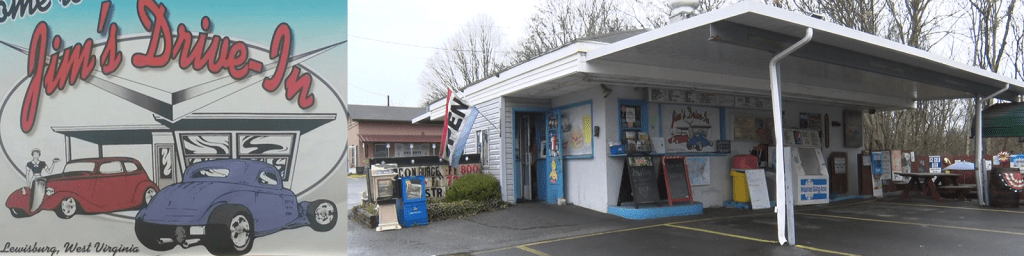
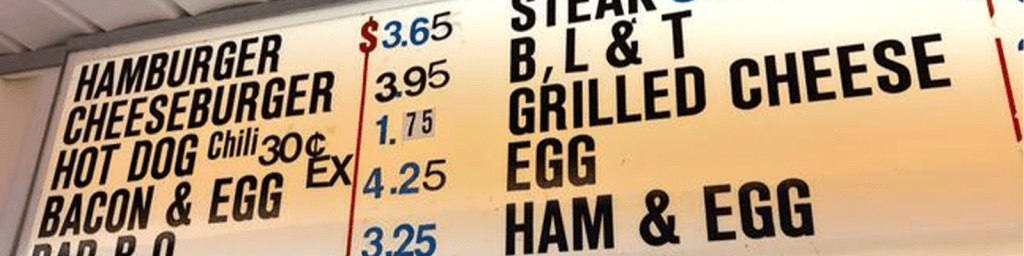
One of my favorite places to eat anytime in Lewisburg, West Virginia, is this little local restaurant called “Jim’s Drive-In.” My attachment to this company goes back to my youth as I’m still a massive fan of their food to this day. This place beginning in 1961, serves as a restaurant primed for the summertime, which functions as a drive-in restaurant. They even include outdoor picnic tables near the establishment where servers from Jim’s Drive-In can aid customers in getting their food. The restaurant offers cheeseburgers, chicken wings, and many fried foods. They also provide a vast selection of milkshake flavors that have no limit in how many flavors you can mix. Sadly, Jim’s Drive-In does not have a website, but they were featured in articles and on a foodnetwork show “Two Men and a Wild River.”
Brandscript Model for Jim’s Drive-In
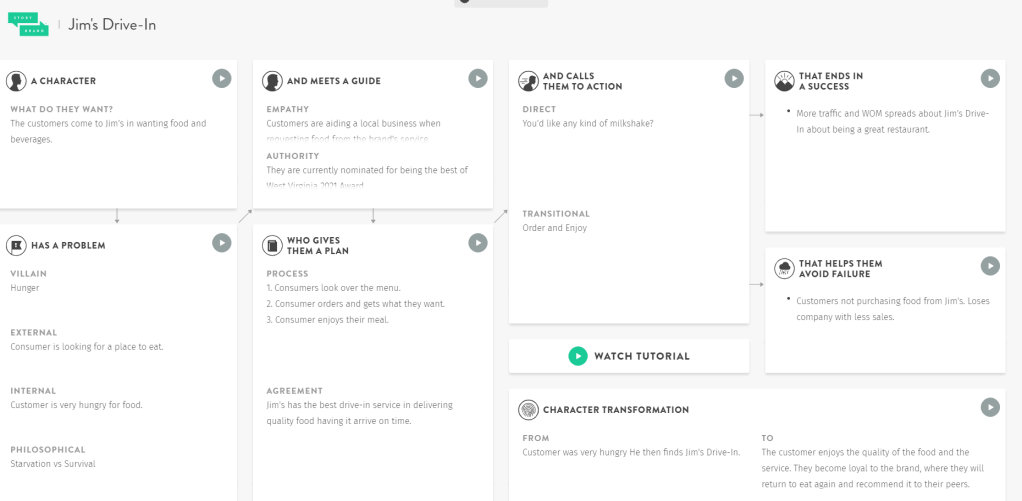
When looking at the steps that outline the brandscript model for Jim’s Drive-In, I had to understand the sensibilities of a small local business that serves food. The character is someone who is looking for food to eat. The customer’s problem is externally finding a place to eat while trying not to eat fast food. Internally, this character has some time on his hands to find a place to eat, but he is exhausted from eating the usual fast-food grub and is not looking to eat inside a restaurant, mainly from not wanting to spend too much time and money. I would consider Jims to not be swift like fastfood but faster than the typical sit-down restaurants. The villain is hunger, while the philosophical conflict is survival against starvation. I considered these to be the problems because obviously, customers are looking for a place to eat because they are hungry. While that is the case, there are many places to eat among Jim’s Drive-In, and it would be hard to tell if they would commit to ordering from the restaurant depending on how they want to use their time and money.
The process continues with the consumer meeting their guide or waiter/waitress that works to serve the consumer food. The guide emphasizes their role by providing service of delivering the food from the menu the consumer orders. Their authority as a guide is supported by highlighting the restaurant with ‘the best of 2021 in West Virginia award’ nomination. This award nomination would hopefully boost their reputation and trust for people interested in purchasing food from them. The plan given to the consumers from the guide is the menu, where the consumers look over it and eventually decide to make their order. Then the service delivers in bringing food back to the customer that is satisfying for them. Hopefully, the plan satisfies the customer in alleviating their stress from how fast the order comes through and the cost of their meal.
A call-to-action or slogan I would make for the company would be – “Drive-In and enjoy.” This direct slogan helps boost the brand’s reputation to be more dedicated to delivering good food for the customer. I also designed it to make it seem like it might be a better investment for someone who intended on going through a drive-through, whereas they can drive in for something of a different quality. The transitional call to action is “eat and go!” to endorse their ability to use time well in making customers’ orders. This result succeeds by having the customer satisfied with their order and service, making the customer come back again and spread WOM to his peers about the restaurant. By abiding by the customer’s needs in having service and food delivered promptly, the brand is likely to succeed if advancing with a new motto. Whereas if the brand doesn’t meet customer expectations, they have to rethink their focus on marketing themselves with time.
The transformation of where the consumer goes is from having a little time to kill more than he regularly uses to drive-through fast food places. Now, the customer wants to find a place with a different quality from fast food without going sit down in a restaurant. Their goal is to save money, time, and something different in quality regarding the food. Hopefully, this transition turns the customer into a fan of the brand from their service delivering good-quality food on time without making a huge cost. Hopefully, the customer will create awareness by spreading word-of-mouth to peers. Along with that, the customer will return.
A Jim’s Drive-In Commercial
To promote Jim as an ad, I would use the slogan “Drive-In and enjoy” mainly to boost the awareness of the drive-in restaurant. My advertisement would consist of a day in the life at the Jim’s Drive-In, while having a little montage that focuses on the food menu, the waiters providing food, and features a shot of where it’s located in Lewisburg. The restaurant’s target audience will be people interested in getting their food faster while having it seem relaxing. Using the Elaboration Likelihood Model to help influence the making of this advertisement would be considered a peripheral route to persuasion since food is a low-involvement product. Meaning, this ad would be straight to the point in showing people eating food, being served food from their car, and having quick service would be the only sensibilities to encourage new customers. Another concept to reference would be the hierarchy of needs, which organizes needs according to their priorities. For Jim’s Drive-In, it would fit a physiological need. Every need comes with a classification on what product it is and its promotional appeal (contemporary advertising). The advertisement made for Jim’s would likely include the slogan or promotional appeal for “enjoying foods you enjoy.” The menu doesn’t offer any healthy food choices, so it’s best to market the fried foods and the multiple milkshake flavors provided. This concept designates the purpose of how a product sells as it’s part of our wants.
References
Arens, William F., and Michael F. Weigold. “Chapter 5 - Marketing and Consumer Behavior: The Foundations of IMC.” Contemporary Advertising and Integrated Marketing Communications, McGraw-Hill Higher Education, New York, 2021, pp. 148–179.

Miller, Donald. Building a StoryBrand. Harpercollins Leadership, 2017.

About Jim’s Drive-In
Jim’s Drive-In featured on foodnetwork
Jim’s Drive In Facebook Page
Best of 2021 Award - Jim's Drive-In
Menu of Jim’s Drive In

Brandscript of Jim's Drive-In
Star Wars Poster
Blog #1 – The Evolution of Advertising
Advertising has advanced over the past several decades, to the point where the medium seems to keep expanding and innovating into new territories. After watching the documentary “Spin and Sell,” the continuation of advertising through the years has made it seem like the world has never embraced advertisements as much as they do today. The goal is to attract new customers, but the medium of advertising has created a new wave of customers by providing loyalty, community, and accommodation.

Early Beginnings
While the German goldsmith who created the printing press in 1436 innovated the advertising landscape moving forward, he wasn’t the first to make his own. China influenced Johannes Gutenberg’s invention from their printing press to the 9th century with woodblock printing. As far as Gutenberg is concerned, his invention went on to help mass-produce books in Europe, which caused literacy and book sales to increase. Scribes were then in high demand along with printing material that created an industry of booksellers and printers. After newspapers arrived in the new world in the 18th Century, someone who became significantly influenced by the printing press was Founding Father Benjamin Franklin (history.com).
Newspapers then became a way of advertising using text with illustration, something Ben Franklin helped innovate for future advertisements in the medium. Working under an alias after he moved to New York, Franklin illustrated a political cartoon for a newspaper called ‘The Pennsylvania Gazette.’ The sketch created in the summer of 1754 was titled “Join or Die,” which represented the importance of unity compared to having the new world pictured colonies as pieces of a snake’s body. The graphic was rehashed on various mediums with different labels and was even used to display America’s oppression felt by the British around the Revolutionary War (illustrationhistory.org).
The beginning of the 20th century created a boom for two new mediums of advertisements; Radio and television became the latest innovations to change the way businesses, consumers, and marketers look at advertising. Like the way newspapers and magazines illustrated their advertisements directly for the viewer, tv and radio worked in the same way. When making advertisements, they would have to make it look and appeal to an audience group they’d hope to encourage to purchase their products. For example, in the 1930s, the radio would play ads for ‘Oxydol’, a typical product used for laundry. This ad played during Soap Operas to appeal to the housewife demographic, the designated target audience based on those who listened to the soap opera. These kinds of ads were known as commercials, which can be argued as the most popular advertising medium today.
Today’s types of advertisements now range from having different brands that can appeal to the same consumers. Back then, marketing was mainly informative and direct, whereas advertisements today can make them straightforward to indirect or informative to comedic. There’s barely any boundaries for what advertising can do to sell products, as the message is now more about appealing to the individual rather than the demographic.
The Legacy of Advertising
Much of the advertising we’ve seen throughout the years in America, especially during the 20th century, influenced a legacy of advertising we see in today’s climate. A sprout of different tactics arose for the advertising landscape when video and sound came into the fray. This technology gave marketers a new avenue to lend creative and business ideas to new heights. Though, companies and organizations eventually had to start finding better ways to advertise themselves because competition started to appear. With the growth of new businesses, much of their competition was between products of two separate companies that offered the same thing. I think this rise of competition encouraged companies to shift in how they were advertising. It would encourage companies to eventually create an identity for their product by experimenting little by little into what they are now.
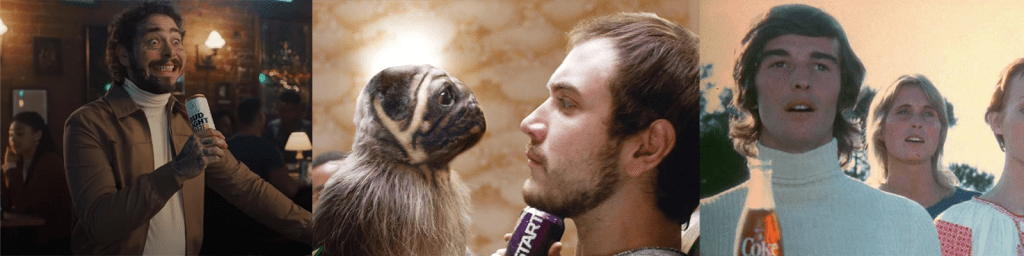
Commercials, one of the most prominent advertisement mediums today, were being used to test their identity and how they wanted to convey the company’s/ organization’s messages. The start of commercials especially was an era when companies were using the medium to present and expand themselves. With a product like Coca-Cola, I think it found its footing for what it knew how to personify itself from the Hilltop commercial that premiered in the 1970s. The commercial prompted the mantra of ‘wanting to buy the world a coke’ said and featured by a group of diverse young people who sung a catchy jingle while they all held full glass bottles of coke. The commercial provides a catchy song, an old and clever tactic to make an ad more memorable. It also seemed to promote sanctity, peace, and unity between all types of people while still connecting back to the refreshing taste of Coca-Cola with a trademark at the end stating ‘its the real thing.’
I think the influence of this commercial changed the landscape of advertising for products that are as popular as Coca-Cola. What is very smart about it is that it doesn’t appear evident as if a company is trying to sell its product blandly. Even more so, it doesn’t exude a company’s desperation for the consumer’s money, and nor was it bland in telling you to buy their product without any facts – because that’s not what kind of ad it should be. Everyone knows what Coca-Cola is, and having it be one of the biggest recognizable brands in the world, and there’s no reason why they need to tell you what it is. What they did instead made a catchy jingle that could stick in someone’s brain while knowing it’s an advertisement for a type of product that isn’t going to immediately encourage the consumer to go out and buy a coke. Also, the commercial seems to appeal to the young adult crowd and could influence older viewers to have a soda to make them feel nostalgic. It’s an advertisement that makes the product stay in the back of your mind whenever you go out, influencing you to buy the product. The Puppy Monkey Baby Ad from Mountain Dew or the Post Malone Bud-Light Seltzer Commercials are very similar. It doesn’t directly tell the consumer to purchase the product, but it possibly influences the viewer to buy it. The crazy catchy jingle and the weird animal mashup you see in the puppy monkey baby commercial is so strange, but it adheres to capturing the viewers’ attention. The Post Malone ad features a celebrity, showcases the new bud light seltzer, and has a comedic sci-fi narrative play on how the body reacts when drinking the product – and yet it captures your attention from using those three creative factors into it. While the newest commercials are more comedic examples than the coke ad, they all represent a common good you can buy almost anywhere. They are promoting a product that has a method to stick into viewers’ heads to influence them to purchase the product possibly.
Some ads sometimes focus on being informative and direct, which usually tackle societal issues, political campaign ads, anti-smoking facts, and vice-versa. Many ads have messages that aren’t always selling a product but inform details that can encourage a viewer to support a cause financially. They’re mainly in noncommercial ads, which generally express the aid for charities and institutions. Their marketing method tells the public to help by supporting the organizations’ cause to improve societal problems like homelessness, starvation, cancer, and much more. A commercial that comes to mind that’s a very impactful strategy is the “you can quit” smoking ads that showcase people who have suffered physically from their tobacco addiction. In a way, this can influence addicted smokers to let go of their habits or at least break away from them. With the catchy jingle from the Coke commercial in 1970 to the shocking quit-smoking commercials made in the 2010s, the science has dramatically shifted to satisfy consumers. These commercials have developed a strategy in order to how they want to present their products from knowing what they are. These commercials aren’t specifically made for anyone, but they attract attention and influence people’s behaviors by creating a poignant message about smoking to a goofy commercial about mashed-up animal featuring a common good.
The Future
Selling products has become a lot harder due to the emergence of new companies. With more companies created today than ever before in America, it creates competition between brands; The fight to win over the consumer from having a similar product. To fight against this problem, companies created brand loyalty with their consumers with rewards, memberships, discounts, clearance sales, etc. This paradigm shift gives consumers a choice in which they decide upon from how they spend their money. It not only applies to a retail store or a rewards program; multiple types of noncommercial advertising have the same dilemma, with many organizations supporting the exact cause. Instead of just being influenced by advertising of one product, brand, or organization, there are now multiple ways for a consumer to decide.
With the array of influences, brand loyalty offerings, competing businesses, and evergrowing growth of technology, there may be too much information that prevents the potential consumer from finding what they want. I think advertising will remain the same as it is now, but with the advancement of personalized ads, digital ads will likely be the attraction for the future. Audiences or Individuals are now mainly targeted with advertisements from their behaviors after surfing the web. Promotions and their messages have changed over time in various ways compared to the beginning of advertising seemed to be very simple, direct, and informative. Companies can rely on the web to promote people interested in their product by what they individually search. I would also consider how advertising is becoming harder to appeal to a demographic. In contrast, people consume so much content that it’s hard to wager even on what an individual would click on. So I would say in the next couple of decades, advertising will still be the same as it is but will probably emphasize personalized advertising from the internet even more.
Where do we go from here?
Advertising is an ever-evolving form of attracting new consumers that have grown into a behemoth. I’m slightly worried about how it will evolve if plans for creating personalized advertisements are what the future may entail on how companies can attract new customers. Maybe it’s alot easier for companies to attract consumers by throwing stuff at the wall and seeing what sticks. I do see a possibility for commercials to experiment in creating ways for consumers to trust them and find interest in their products. Do you think it’s becoming harder for companies and organizations to attract new consumers? It almost seems like a gamble for how advertisements can appeal to consumers without the personalized ads.
References:
https://www.youtube.com/watch?v=YPBf7km7NAk – Spin and Sell
https://www.history.com/news/printing-press-renaissance
https://www.illustrationhistory.org/artists/benjamin-franklin
https://www.youtube.com/watch?v=C2406n8_rUw – Hilltop Ad Coca Cola
https://www.youtube.com/watch?v=Zwy1o8UOK7A – Post Malone bud-light seltzer ad
https://www.youtube.com/watch?v=nQcfK9EKfL4 – Puppy Monkey Baby Ad
https://www.youtube.com/watch?v=PbvOHUiIP2M – You can quit smoking ad
 The Armada
